






News

Period
article

02 April 2025

By: Com

Publications 2024

Liste des publications 2024 de l'ensemble des laboratoires composant la FR AIB (IF 2023). Éléments collectés et consolidés par Solange Cassette, documentaliste à la fédération. Publications list in 2024 of all members of FR AIB laboratories (IF 2023). Items collected and consolidated by Solange Cassette, library ressources manager.
Vignette appel a projet 2025 © FRAIB
article

29 April 2025

By: Com

Call 2023 is now open

Two distinct projects can be submitted. The first call concerns projects led by researchers from at least two different laboratories from the FR AIB. The second call concerns young scientists (PhD students, post-docs, engineers on fixed-term contracts).
article

23 April 2025

By: Com

Call 2024 is now open for young scientists and inter-units

For this 2024 edition, the Research Federation is launching two calls for projects: the first for inter-unit projects and the second for projects by young scientists (PhD students, post-docs and engineers on fixed-term contracts).
Publications année 2023
article

29 April 2024

By: Com

Publications list in 2023

Publications list in 2023 of all members of FR AIB laboratories (IF 2021). Items collected and consolidated by Solange Cassette, library ressources manager.
bandeau K Sohn
event

08 February 2024

11am - Lynn Margulis seminar room (PABS-B)

K. SOHN - Mechanisms by which convergently evolved NLRs recognize pathogen effectors in plants

Keehoon Sohn leads the group « plant immunity » at the Seoul National University. He will present his work on 8th February at 11am in the Lynn Margulis seminar room (PABS-B).
article

07 November 2023

By: Com

Publications 1er semestre 2023

Liste des publications du 1er semestre 2023 de l'ensemble des laboratoires composant la FR AIB (IF 2021). Éléments collectés et consolidés par Solange Cassette, documentaliste à la fédération. <em>Publications list for the first semester of 2023 of all members of FR AIB laboratories (IF 2021). Items collected and consolidated by Solange Cassette, library ressources manager.</em>
event

19 September 2023

Lynn Margulis auditorium - AgroBiosciences building - Auzeville-Tolosane

Forum 2023: LabEx TULIP / FR AIB

The FR AIB and LabEx TULIP jointly organise their annual forum on October 12 and 13 in the brand-new Agrobiosciences building. The first half-day will focus on the FRAIB environment, with an overview of the technological facilities, followed by Young Scientists talks, granted in 2022. During the following afternoon and Friday, TULIP LabEx will present a program combining presentations by its members and international guests.
bandeau appel à projet 2023
article

31 August 2023

By: Com

Call 2023 is now open

Two distinct projects can be submitted. The first call concerns projects led by researchers from at least two different laboratories from the FR AIB. The second call concerns young scientists (PhD students, post-docs, engineers on fixed-term contracts).
Camille Parmesan
article

07 July 2023

By: Solange Cassette

Camille Parmesan: From passion for butterflies to climate change expertise

The current Director of SETE, Camille Parmesan, shares her enthusiasm for science, her passion for butterflies and her commitment to climate. This portrait shows her vitality, clairvoyance and combative spirit that are as many remedies to solastalgia*.
article

06 June 2023

By: G. Esteve

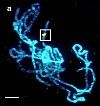
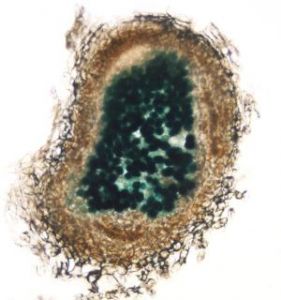
An integrated analysis of plant and bacterial gene expression in symbiotic root nodules using laser-capture microdissection coupled to RNA sequencing

Rhizobium-induced root nodules are specialized organs for symbiotic nitrogen fixation. Indeterminate-type nodules are formed from an apical meristem and exhibit a spatial zonation which corresponds to successive developmental stages. To get a dynamic and integrated view of plant and bacterial gene expression associated with nodule development, we used a sensitive and comprehensive approach based upon oriented high-depth RNA sequencing coupled to laser microdissection of nodule regions.
vignette debelle
article

06 June 2023

By: GE

Genome of model legume Medicago truncatula sequenced

Dans le cadre d'un consortium international, des chercheurs du LIPM (INRA-CNRS), en collaboration avec le Génoscope (CEA- Institut de Génomique) sont parvenus à séquencer le génome d’une légumineuse modèle proche du pois ou de la luzerne cultivée : Medicago truncatula. Le séquençage de son génome donne accès aux gènes d'intérêt potentiellement utilisables pour d'autres cultures. Cette légumineuse a en effet une capacité intéressante, elle fixe, grâce à une symbiose avec des bactéries, l’azote présent dans l’atmosphère. Elle ne requiert donc pas, contrairement à beaucoup de ses semblables, d’intrants... Une recherche qui, transférée à d’autres espèces, ouvre la voie à une agriculture plus respectueuse de l’environnement.
vignette stevens
article

06 June 2023

By: GE

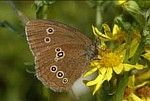
How is dispersal integrated in life histories: a quantitative analysis using butterflies

As dispersal plays a key role in gene flow among populations, its evolutionary dynamics under environmental changes is particularly important. The inter-dependency of dispersal with other life history traits may constrain dispersal evolution, and lead to the indirect selection of other traits as a by-product of this inter-dependency.
Chabot
article

06 June 2023

By: Gael Esteve

Do stream fish track climate change ? Assessing distribution shifts in recent decades

Understanding the ability of species to shift their distribution ranges in response to climate change is crucial for conservation biologists and resources managers. Although freshwater ecosystems include some of the most imperilled fauna worldwide, such range shifts have been poorly documented in streams and rivers and have never been compared to the current velocity of climate change. Based on national monitoring data, we examined the distributional changes of 32 stream species in France and quantified potential time lags in species responses, providing a unique opportunity to analyse range shifts over recent decades of warming in freshwater environments.
Sunflower cover
article

06 June 2023

By: G. Esteve

Tournesol : un nouvel outil pour mesurer le manque d’eau

Plant or soil water status is required in many scientic elds to understand plant responses to drought. Because the transcriptomic response to abiotic conditions, such as water decit, reects plant water status, genomic tools could be used to develop a new type of molecular biomarker.
article

06 June 2023

By: G.Esteve

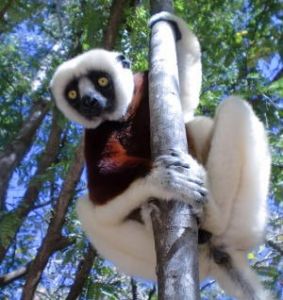
A "B plan" for Biodiversity ?

The most threatened mammal group on Earth, Madagascar’s five endemic lemur families (lemurs are found nowhere else), represent more than 20% of the world’s primate species and 30% of family-level diversity.
nodule
article

06 June 2023

By: C.Masson & G.Esteve

Transient Hypermutagenesis Accelerates the Evolution of Legume Endosymbionts following Horizontal Gene Transfer

Horizontal gene transfer has an extraordinary impact on microbe evolution and diversification, by allowing exploration of new niches such as higher organisms. This is the case for rhizobia, a group of phylogenetically diverse bacteria that form a nitrogen-fixing symbiotic relationship with most leguminous plants. While these arose through horizontal transfer of symbiotic plasmids, this in itself is usually unproductive, and full expression of the acquired traits needs subsequent remodeling of the genome to ensure the ecological success of the transfer. Here we uncover a mechanism that accelerates the evolution of a soil bacterium into a legume symbiont.
AfficheForum 2015
article

30 June 2023

By: ComFRAIB

Forum interne 2015

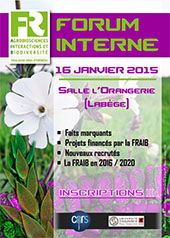
L'édition 2015 du forum interne de la FR AIB s'est déroulée le 16 janvier 2015 à l’Orangerie de Labège. Quatre points au programme : Faits marquants, Projets financés par la FR AIB, Nouveaux recrutés, La FR AIB en 2016 / 2020
Blé
article

06 June 2023

By: H. Bergès, A. Bellec and M. Aizpuru

Structural and functional partitioning of bread wheat chromosome 3B

Publication of the first reference sequence of the biggest bread wheat chromosome. Thanks to an international collaboration, coordinated by INRA jointly with CEA (Genoscope), CNRS and Université d’Evry in France, this major achievement will allow the identification of numerous genes of agronomic interest, and accelerate wheat improvement. Results are published in Science on July 18th, 2014.
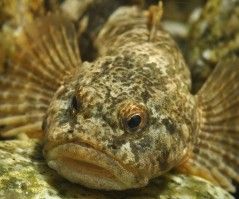
Barbeau <i>Barbus barbus</i>
article

06 June 2023

By: M. Aizpuru

Species traits and phylogenetic conservatism of climate-induced range shifts in stream fishes

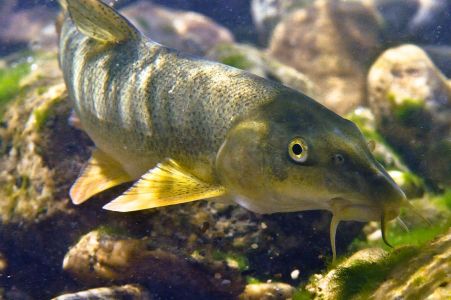
Understanding climate-induced range shifts is crucial for biodiversity conservation. However, no general consensus has so far emerged about the mechanisms involved and the role of phylogeny in shaping species responses has been poorly explored. Here, we investigate whether species traits and their underlying phylogenetic constraints explain altitudinal shifts at the trailing and leading edges of stream fish species ranges. We demonstrate that these shifts are related to dissimilar mechanisms: whereas range retractions show some support for phylogenetic clustering due to a high level of conservatism in thermal safety margins, range expansions are underpinned by both evolutionarily conserved and labile traits, notably trophic position and life-history strategy, hence decreasing the strength of phylogenetic signal. Therefore, while climate change brings many difficulties in establishing a general understanding of species vulnerability, these findings emphasize how combining trait-based approaches in light of the species evolutionary history may offer new opportunities in facing conservation challenges.
herbarium specimen
article

06 June 2023

By: M. Aizpuru

From museums to genomics: old herbarium specimens shed light on a C3 to C4 transition

Collections of specimens held by natural history museums are invaluable material for biodiversity inventory and evolutionary studies, with specimens accumulated over 300 years readily available for sampling. Unfortunately, most museum specimens yield low-quality DNA. Recent advances in sequencing technologies, so called next-generation sequencing, are revolutionizing phylogenetic investigations at a deep level.
injection
article

06 June 2023

By: Gael Esteve

Multihost Experimental Evolution of the Pathogen Ralstonia solanacearum Unveils Genes Involved in Adaptation to Plants

Ralstonia solanacearum, the causal agent of a lethal bacterial wilt plant disease, infects an unusually wide range of hosts. These hosts can further be split into plants where R. solanacearum is known to cause disease (original hosts) and those where this bacterium can grow asymptomatically (distant hosts). Moreover, this pathogen is able to adapt to many plants as supported by field observations reporting emergence of strains with enlarged pathogenic properties. To investigate the genetic bases of host adaptation, we conducted evolution experiments by serial passages of a single clone of the pathogen on three original and two distant hosts over 300 bacterial generations and then analyzed the whole-genome of nine evolved clones.
  • 1 (current)